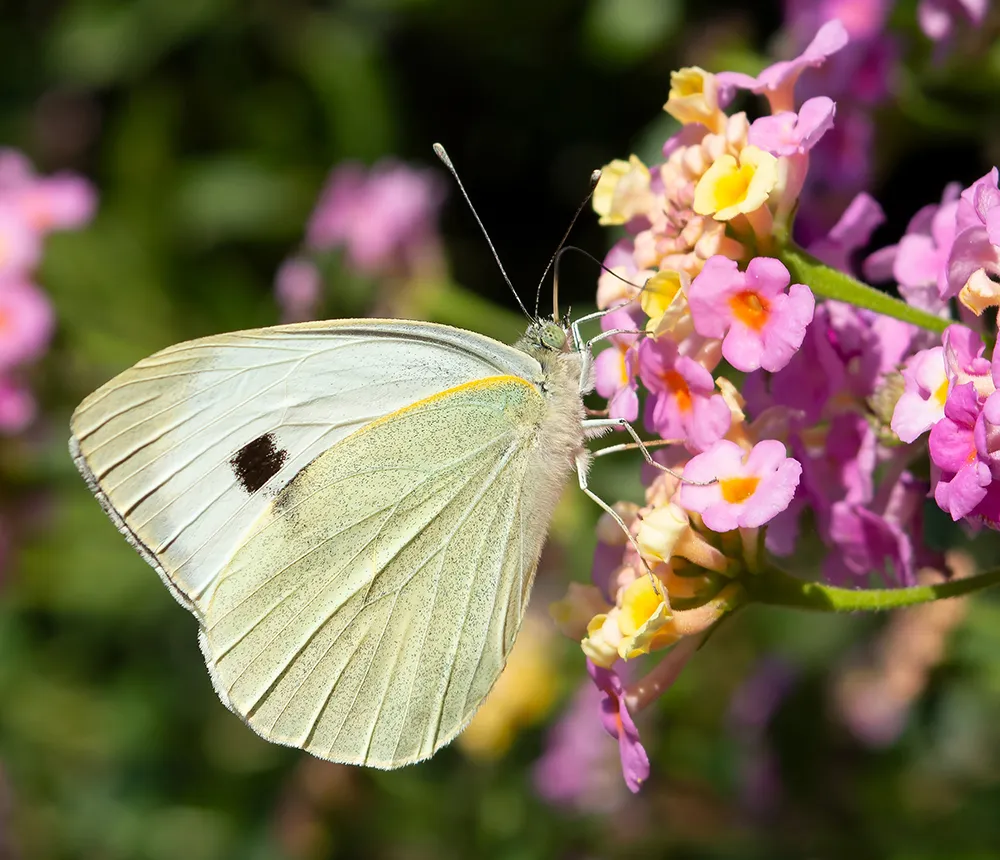
The large white, Pieris brassicae, is a common white butterfly of Europe, North Africa and Asia, named for the brassica crops its caterpillars eat. It belongs to the family Pieridae, and its closest relative is the smaller, more familiar small white, Pieris rapae. The species is common throughout Europe, North Africa and Asia to the Himalayas, with established populations also in South Africa.
Identification
It is a medium-sized white butterfly, with a wingspan of 58 mm in males to 63 mm in females. The upperside is white with black tips on the forewings; the underside of each wing is a pale greenish colour that camouflages the butterfly at rest. The sexes can be told apart. The female carries two black spots on each forewing and broader black markings overall, while the male lacks the spots and shows less black scaling at the wing base. On the underside, females show a light ochreous yellow on the hindwing, against an ochreous brown in males.
Range and habitat
The butterfly favours open spaces with cruciferous plants: farmland, vegetable gardens, allotments, parks, meadows, open grassland and hedgerows, confirmed by UK Butterflies for the same habitats in Britain. Its wide range across temperate and subtropical Eurasia tracks the availability of brassica host plants rather than any single climate band.
Life cycle and host plants
Caterpillars feed on cruciferous (Brassicaceae) plants, including cabbage, Brussels sprouts, cauliflower, kohlrabi, oilseed rape, swede and turnip, as well as nasturtium, sea-kale and wild mignonette. Females lay their eggs in clusters on the underside of leaves, favouring green surfaces, and may lay several clusters within about a week. The caterpillars pass through five instars, starting pale yellow with brown heads and developing bright yellow-and-black markings by the final instar; after hatching they live together as a group for a time before dispersing. They store toxic mustard oil glycosides from their host plants, which makes them distasteful to birds and other predators, their bright colouring serving as a warning. The species overwinters as a chrysalis, and produces two generations a year in Britain and continental Europe, occasionally a third in favourable conditions.
Because the caterpillars feed voraciously on brassica crops, the species is a significant agricultural pest across much of its range, though attacks are localised and currently less severe in Britain thanks to natural and chemical controls.
Behaviour and flight period
In Britain and continental Europe there are two broods: a spring generation flying from April with a peak in May, and a summer generation from July into early September, with a third possible in warm years. Mating is mostly monogamous, though some females mate more than once, and copulation is followed a few days later by the first batch of eggs.
Similar species
- Small white (Pieris rapae): the species most often confused with it, smaller and with less black on the forewing tips; in North America the name “cabbage white” refers to this species rather than the large white.
- Green-veined white (Pieris napi): a similar pale butterfly sharing the same open, flower-rich habitats across much of Europe.